

History
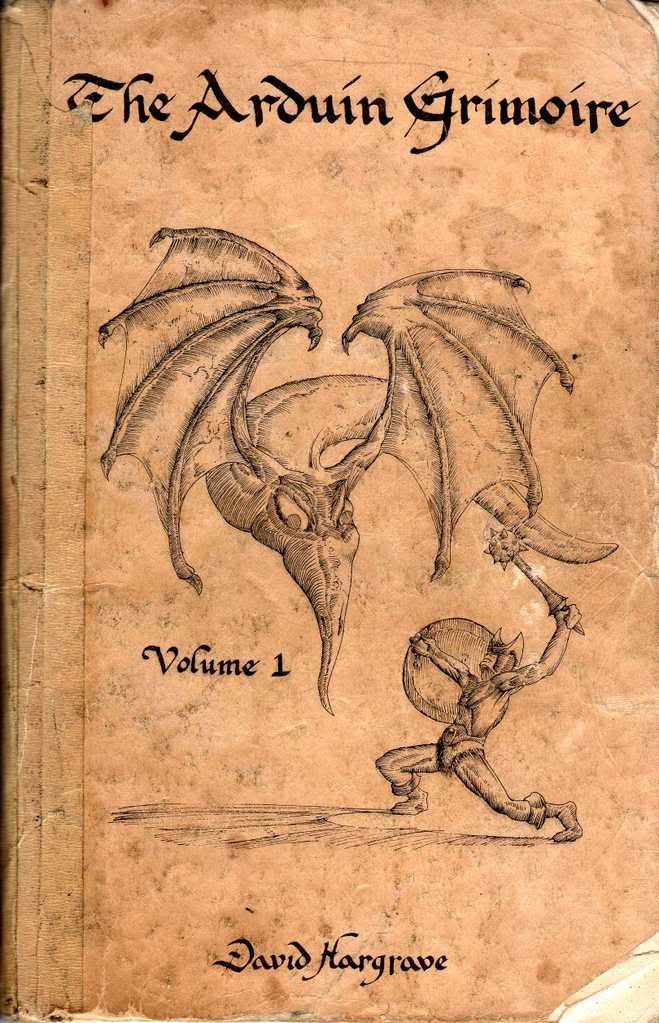 Remember how last time I talked about All The Worlds' Monsters, Vol. I, I mentioned that it was supposed to be a collection of all the best monsters published for D&D in various fanzines and other publications? Steve Perrin also wanted to publish at least one monster from every DM out there at the time which, admittedly, was such an impossible task that I doubt Mr. Perrin ever actually meant to accomplish it. So, when Steve got a bunch of monster submissions from DMs, he justi published that as ATWM1. ATWM2 fulfills Perrin's original vision and reprints many monsters that were printed elsewhere previously, particularly in the pages of the Dungeoneer, Alarums & Excursions and in Dave Hargrave's Arduin Grimoire. I think it's particularly great that the Arduin Grimoire stuff is reprinted here, and I think it gives the modern reader a sense (if only a conceptual one) of the wide-open nature of "back-in-the-day" OD&D, where everything was fair game and concepts like "product identity" had yet to grip the hobby. It feels something like discovering that there was a "West West" of the gaming hobby, that I had missed it, that no one was really talking about it and I had the clues to its existence in my hands. What do the "A&E," "Dun" and "AG" followed by a number in the parenthesis after the authors' names mean? Who knew? (Well, it turns out I could have known all this shit all along if I'd only been paying attention and reading things like forewards to the text and such, but, 13 remember?)
 Details

I've got to say, the more time I spend with the ATWM series, the more love the way they're laid out. The landscape view works out fantastically well these days, particularly since the pages fit so well on a computer screen or on my Kindle. Coming in at 112 interior pages containing 243 monsters, ATWM2 is no slouch. The book includes a reprinting of the Perrin Conventions (which only takes up one page and is completely necessary to make sense of some of the rules), advice from Ken St. Andre on how to convert the monsters to Tunnels & Trolls (I'll admit I've not read that part, largely because I still don't get T&T and am okay with that), and several indices (one for this volume, one for both volumes thus far and one for the monsters by dungeon level... god I love dungeon level). If this volume were published in today's gaming climate, you'd expect there to be another index that lists the monsters by source for stuff from A&E, Dungeoneer or Arduin, but that just wasn't how they did things back then, so we won't find it here.
Aesthetics
Yup, this is an ATWM book, and like its predecessor, it features sparse art, but the art that's present is very evocative line art. Most of the art here is better than in Volume I (the Christ Lofthus and Sherry Kramer illos are the best!), with some notable exceptions (the "Dartwing" looks like a schoolkid's rendition of a scene from a Woody Woodpecker cartoon). The "pages typed on a word processor" look is back for round two, and it acquits itself very well. I love the blocky, naive, "bright-eyed and full of promise" childlike optimism of the typeset.
For all the greatness of the physical aesthetics, there's one sticking point with the design aesthetics that really gets to me. Nearly every monster in the volume is immune to something or another, and it's usually things like charm-magics. A few times, the immunities are prohibitive, as if the writer expects the players to defeat the monster in one specific manner and that's it. To me, that's exceptionally poor (or lazy) design that robs the players of creativity, a "gotcha!" sort of design that just doesn't jive well with my sense of how the game should be played. When using any of these monsters, I'd have to scrub those details right off.
Foliosity
We now enter a strange space where ATWM2 stands remarkably apart from ATWM1. Since many of the monsters published here appeared elsewhere before, the design of many of these monsters, as I see it, the design decisions that go into the making of the monsters found in early White Dwarf's Fiend Factory column, the precursor to the Fiend Folio. Thus, many of the monsters here are monsters designed for a purpose, to fit a specific niche within a dungeon, to be a setpiece monster rather than just a random encounter. There are only a very few multipurpose "orc-type" monsters here (like the "Erb"), thankfully, so our separation of wheat from chaff is more about looking at what bits of a particular monsters aren't awesome (and then tuning them to be awesome) rather than picking out the pointless from the fun. Some monsters are present merely to be the punchline for a joke (such as the "Wandering Minstrel Eye" and the "Wandering Monster Eye"), and those can still be workable, as long as the joke is set up correctly. In short, with ATWM2, we see the beginnings of the design aesthetic that culminates in the greatest monster book known to man, the Fiend Folio, and the monsters herein just need a little nudge to get over the hump to be perfectly usable and Folioic fiends.
Final Word/What I'm Stealing
This one is going on the shelf of "places to look for interesting setpiece monsters to fit specific niches." That statement, to me, tends to mean "dungeon inspiration." Who wants another dungeon full of orcs and goblins with no real character or life of their own? I'd rather have an interesting space built in a thoughtful manner that includes challenges and tricks that require some thought to get through and that the players will remember for years. So yeah, that's what I'm stealing: whatever I can steal that will make my game more fun. Which is a total cheat of an answer. I could say that for every book. But really, this one will require enough work to any monster in particular that I can't even predict what I might like to steal. In the end, though, I think that this book will play a bigger role in, say, the OD&D game I plan to run for some younger gamers soon rather than something like my DCC games. Then again... DCC might be just the environment for some of the stranger stuff in the ATWM series...





![[No Verfication] Dreamarket.App Dream League Soccer 2020 News Proof 999,999 Diamons and Coins](https://lh3.googleusercontent.com/blogger_img_proxy/AEn0k_sEBD-66Ky4qf1YNxssO1jLT3KZdbz661Xdx_b2z9KMt5pPop2NKynzhaTElwiaBztjF_si7EuM7ln0FhXdKDY4730RUDkx0rnUFqQCFNo4JoxP5FgXnew=w100)


0 Yorumlar